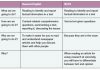
What is your understanding of ‘communicative’?

What I would see as at the heart of the communicative approach is to maximise the amount of language being used within a school. This can be achieved by not upholding a strict delineation between the classroom and the wider activities of the school.

In short, it’s less about the content of lessons than in the way it is taught. For me, it’s about creating an environment which is language rich and to try and break down the inherently artificial character of the classroom. To put it another way, the bits of chat you have in the corridor, in the social areas of a school, or before a class officially starts, are an integral part of the teaching and learning experience.

In my time in ELT, I’ve generally felt a sense that lots of teaching and learning opportunities were overlooked, unexploited. In this piece I want to focus on two areas of ‘underexploitation’. The first of these is classroom language and the other is wringing more from published materials.

Classroom language

I’ve previously written (Ellis, 2020) about classroom language as something that offers a fantastic opportunity to introduce students to high frequency utterances. Further, many of these are also very useful outside the classroom (Say again?; Sorry?; I’m not with you; Can anyone lend me______?; What does X mean?; Where’s the loo?). This is in line with one core tenet of the communicative approach which is to develop the learner’s ability to communicate effectively in real-world situations.

Also, providing students with such functional language at the moment of need is a pure model of language teaching, as there is nothing forced or artificial about it. In other words, it’s the idea that learners acquire language best by using it for real purposes, rather than simply studying how the language works. That insufficient attention on classroom language is something that I constantly see, even when observing experienced teachers.

As part of a day of peer observations, I recently ended up sitting in on four different classes in one morning. The classes were all of different levels (from A1 to C1), but the students all seemed deficient in classroom language. In particular, the ability to express incomprehension in a comprehensible and authentic way (e.g. ‘Sorry, I’m not with you). On the evidence of teaching in a number of different schools, I have a sense that this is a widespread deficiency. Arming students with a good range of classroom language, early in their period of study, is low hanging fruit in terms of creating a more communicative environment in a school. As well as acting as a classroom lubricant, classroom language also introduces students to important aspects of spoken English, such as connected speech (whatdyerreckon?).

Unexploited exercises

In addition to ‘underexploiting’ classroom language, I often feel that teachers overlook the full potential of the materials they use. This was well illustrated by a class I observed a few years ago. Despite the teacher having just completed his CELTA, his class was impressive, with the teacher’s calm authority the glue holding things together. However, the lesson did suffer from something that occurs a lot; underexploited material.

After going through the answers to a gap-fill exercise with the students, the teacher praised the class for their efforts and moved on to the next activity. Looking at the sheet, the gap fill was full of high frequency expressions that, I felt, could have been exploited further. Often, as was the case on this occasion, the sentences in typical gap fills give the students great dialogue starters, something to build from.

For instance, the present perfect sentence ‘How long have you _____ living here’ offers a great opportunity for follow up questions (e.g. ‘What brought you here?’; ‘Where did you live before?) that could have stimulated rich exchanges. Instead, this potential communicative activity was left untapped.

To put it another way, I feel that the communicative element of a lesson can be ratcheted up by building in that expectation that everything a student says can be followed up. In short, creating an environment in which they are encouraged to give it a go and go with it, using the type of approach you would see in improvised comedy and drama; let’s just see where this takes us and see what emerges. Again, an aspect of the communicative approach is that teachers tolerate errors during fluency activities, viewing them as a natural part of the learning process. This reflects that authentic communication involves misunderstandings, cul-de-sacs that need to be manoeuvred out of.

Blending

Dry-seeming, grammar-focused gap fills have a lot of underappreciated potential. They should be considered a springboard. This blending of grammar and communicative activities is present in some older ELT materials, notably Leo Jones’s Communicative Grammar Practice (1992), which uses a communicative rather than structural approach to grammar (Leech & Svartvik, 1992), in line with his student-centred approach (Jones, 2007).

This blend is also evident in Walkley and Dellar’s dialogue-heavy Innovations series (2006) (as well as the excellent accompanying teacher’s resource books). Though outdated in terms of some of the content, the dialogues in Innovations are a great way to get students using authentic chunks of language (the authors sprinkle the text with chunks of ‘real English’, the sort of thing not usually included in coursebooks). Though the same authors’ Outcomes series (2019) has many plus points (not least the fabulous National Geographic photos, which stimulate a lot of discussion in class), its relative lack of dialogues is something I miss.

Modelling conversations not grammar

Walkley himself addressed some of this in an English UK conference presentation, ‘More than just the answers’, I attended in 2019. Walkley noted that teachers reported difficulty using the Innovations coursebooks because, unusually, its units frequently led with dialogues rather than explicit structural grammar explanations. Consequently, Walkley and his co-authors were encouraged to expand the grammar sections of subsequent series (like Outcomes), a shift that inevitably sidelined the focus on dialogues. Wakley regretted this evolution, but felt that teachers could counter this in the classroom. Walkley argued that teachers should proactively encourage students to create their own dialogues, actively utilising the target language and structures provided in the coursebook. This connects to another aspect of teaching that can be overlooked: the importance of reusing and recycling language from previous lessons and also within the same lesson (Ellis & Webster, 2023).

Walkley also discussed the very purpose of dialogues in coursebooks. Teachers should, he argued, remember that the dialogues in books and listening activities are ‘modelling the conversation rather than the grammar’. The aim is to get students holding good conversations not necessarily using the specific grammar. There is a tendency, especially with grammar points, to ’force’ the target language into dialogues, often rendering them inauthentic and unnatural.

Embracing the potential of classroom language and the fuller exploitation of materials are two areas through which I feel teachers can achieve a significantly more communicative classroom. Significantly, these offer teachers ways to create a more communicative environment without upping the hours of preparation. Teachers should grasp this low-hanging fruit.

References

Ellis, C. (2020). ‘Classroom Language’, English Teaching Professional 127 12-14.
Ellis, C. & Webster, K. (2023). ‘Embedding knowledge’. Modern English Teacher 32 3:14–18.
Jones, L. (1992). Communicative Grammar Practice. Cambridge University Press.
Jones, L. (2007). The Student-centered Classroom. Cambridge University Press.
Leech, G. & Svartvik, L. (2013). A Communicative Grammar of English 3rd Edition. Routledge.

More articles

Recent articles

Charlie Ellis
Charlie Ellis
Charlie is a researcher and EFL teacher who writes on culture, politics, sport and specialty coffee. He has published several academic articles on political ideology and culture. His current projects include examining the thought of the political theorist and essayist Bernard Crick, and work on the rich cultural life of the Scottish artist and promoter of the visual and performing arts Richard Demarco. ---- Email: [email protected]