‘Noooooo!’
You’re sitting on the sofa, watching an episode of your latest series, and the protagonist is about to do something really dangerous, deadly or dumb. ‘Noooooo! Don’t do that! Don’t open that door! Don’t trust him! Don’t press that button!’ But you, the poor viewer, have no control over the outcome. You’re just going to have to sit there and let the whole sorry story play out. For good or for ill. Not so with Fiction Express.
Fiction Express is an online platform dedicated to fostering a love of reading. Accessible through schools, we publish five-chapter books in six publishing cycles over the calendar year. Each chapter ends in a cliffhanger with three possible outcomes, and the readers vote on which one they prefer. The chapters are released weekly on a Friday, and the vote is open until the following Tuesday. After that, the rest is in the hands of the author, who must follow the wishes of the readers.
Why take this approach?
Literacy – or the lack of it – is the new pandemic. Some reports suggests that only one in five students understand what they are reading at the age of 12 (Golden Steps, 2025).
Meanwhile, it’s getting harder and harder to convince our students to even pick up a book. Smart phones aren’t the only culprits. For teenagers in Spain, where I live and work, there are many other demands on their time. The school day may last from 9:00 a.m. to 5:00 p.m, and then most students take part in extra-curricular activities. Once you get home from a two-hour football practice, it’s hard to dedicate time to reading for pleasure.
We have to fight for our students’ attention. We have to engage teenagers somehow, and there is nothing more engaging than a ticking clock. With only five days to read the books and be able to vote, Fiction Express readers have an impetus to turn the pages. Reading the same book with their classmates, they also have a clear motivation to complete each chapter. Not only will they have to choose which way to vote, but they also have a forum where they can share their ideas with the author. This all leads to natural language in the classroom as the students discuss the issues raised in the story.
How does it work?
This all has to be done in an easy, accessible way. That’s why we have a dashboard on the site that allows the reader to quickly zip from book to vote, to forum and to online exercises. It tracks the student’s progress too, so teachers can see what their students have read, and which additional online exercises they have attempted.
Why do they keep reading?
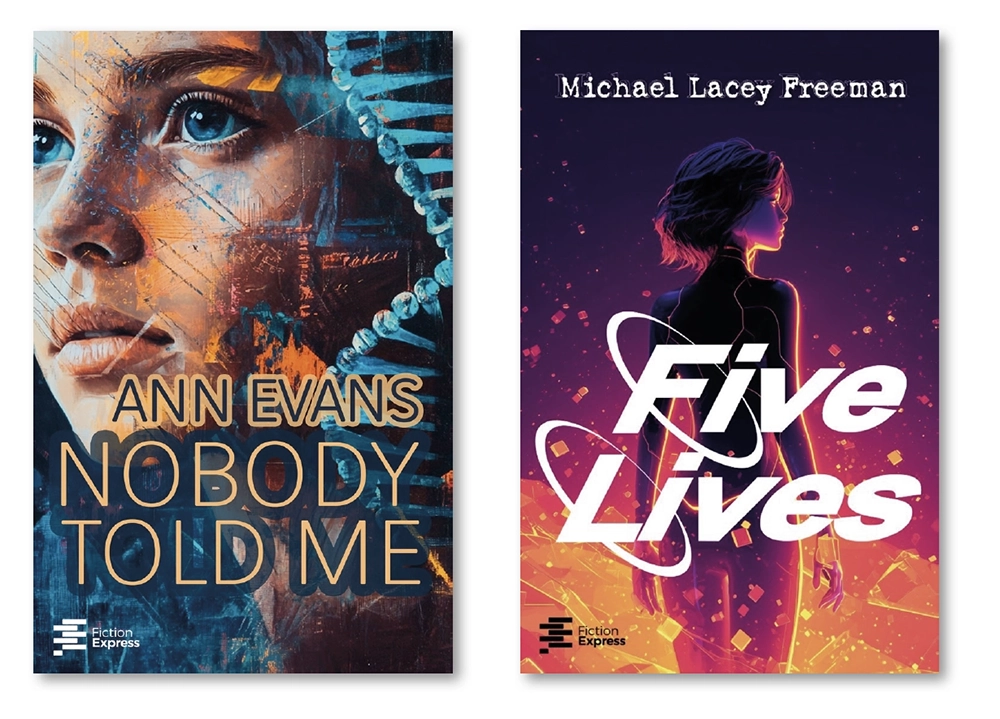
Engagement depends on content that is directly relevant to students’ lives. We seek out topics that will make the students put down their books and think ‘Wow!’. One recent title, Ann Evans’ Nobody Told Me, had students rushing to tell their teachers about a shocking biology lesson. During an everyday science class, a girl called Ella learns that it is extremely unlikely that two brown-eyed parents can have a blue-eyed child, which is exactly what has happened in her family. This chance discovery sets her off on a journey to find out why she was adopted and why nobody had shared this secret with her.
Each book is accompanied by a project. In this case, we were able to use Nobody Told Me to explore different family set-ups and the actual home environments in which people live today. Wanting to focus on engaging issues like these led us to Michael Lacey-Freeman, winner of the 2025 Language Learner Literature Award for his book The Drum. Heretofore, Michael’s writing has had particular success in covering very emotive issues, such as bullying in his most well-known title, Egghead. However, for Fiction Express, Michael had a very different idea in mind – this is what he felt.
Reasons to write
– Michael’s story
For several years, Five Lives existed only as an idea I kept returning to. I had drafted the opening section, but I didn’t have a clear sense of where the story might belong or if it would ever see the light of day. Fiction Express changed all of that.
The story begins on a spaceship, where an alien called Maria transforms herself into a human to search for Daniel, a missing comrade who is stranded on Earth. Once she arrives on the planet, her new body feels heavy and cumbersome, and she loses the powers she had to move with her mind. The only way she can move from one place to another on Earth is by finding Daniel’s fingerprint, which acts as a kind of QR code. By the end of her journey, Maria comes to understand what it truly means to be human. Instead of experiencing her world in terms of data and information, she embraces the wonder of touch, sound, taste, smell and sight through the five senses.
I was really happy when the story finally found its home in Fiction Express. The platform brings together the power of traditional storytelling within a digital space where stories can evolve through real audience participation. Given the opportunity, young readers are more than happy to jump inside stories and become a part of the community of characters they meet along the way. They become co-creators, imagining that they are a part of the action, and they add colour to the story with their own imagination and experience. Fiction Express however, takes co-creation to a new level. Here, the readers can also interact with the author, and they are a part of a community of other readers of the same story. I would often watch the interaction unfolding in real time before my eyes. Students were responding to my question, commenting on the story, making predictions and reacting to each other’s ideas. It was marvellous!
The first chapter release
This interaction never lost its momentum. When my first chapter was scheduled to go live on the platform, I was determined to be there at the exact moment the countdown reached zero. I had a lesson at that time, but the instant it ended I logged in. I was astonished to find that many readers had not only finished the chapter but had already left comments. There were several hundred of them even at that early stage. At the time of writing, the number of comments has risen to 7,635, and it’s still rising – a remarkable sign of genuine, healthy interaction.
The fifty best comments got a certificate. This is a really nice touch. For the readers in general, the certificate is a big deal. An interesting example of extrinsic motivation that encourages readers to get inside the story, make interesting comments and ask engaging questions. In just over a week, I am going to meet these certificate winners online, and I’m really looking forward to it. They, and other readers, have made a big difference to the story in three different ways.
Reader power
Firstly, throughout the process, I felt an obligation to give the reader an adventure. Normally when I write a story, I’m quite removed from the target reader, and I have to make an effort to constantly keep that reader in mind. I send the text to an editor and the whole process unfolds slowly. But here everything is immediate. The reader is right there, breathing down my neck, responding in real time – and that had a huge influence on the way I wrote the story. I would like to think that the experience brought out the best in me in terms of creativity. Once a chapter is sent, there is no going back. If I am on chapter 5, I can’t change a detail in chapter 3 to make a connection or tie up a loose end. I have to work with what I have and make the connection credible otherwise a keen-eyed reader will pick up on it, immediately.
Secondly, the comments also had a huge impact on the story. I found myself trying to pepper and salt the chapter with details that I knew would please the reader, places that the main character would visit, things she could eat or drink and people she would meet.
Finally, there was constant tension between the need to end each chapter with a cliffhanger – so that readers could vote meaningfully on what should happen next – and my desire to give Maria space for reflection and sensory experience. I wanted Maria to learn what it truly meant to be human: to smell the roses, hear the birds singing and feel the wet sand under her feet. Yet at the same time she always had to be propelled forward by events. It was precisely this tension between urgency and introspection that shaped and improved the narrative.
Surprises
Before writing, I believed that I would be able to predict what outcomes the reader would choose, and even if I couldn’t, it would just mean fixing an introduction on to the rest of the chapter which would be the same irrespective of all three outcomes.
I was wrong on both counts. The readers surprised me. At the end of chapter 3, for example, Maria is zapped to a new location. I asked readers if they wanted our heroine to find herself in a crowded football stadium, in the middle of a music festival or at a busy airport. All three outcomes were neck and neck right until the end of the voting process and I had to think of three totally different chapters. Maria being in an airport, a music festival or a football stadium led the story in three totally different directions.
The airport won the day. I was sure it was going to be the stadium or the festival. I believed that the airport was just a boring non-place you use to get to a new destination. Nothing exciting. I was sure that it wouldn’t be chosen. But for a young reader with a big imagination, a child who hasn’t travelled very much, an airport is a very exciting place indeed.
Almost all the readers were supportive and positive about the story. Naturally there were some reluctant readers among the group, but by and large readers were keen to ask that magical question: what happens next? The walls of their classroom were extended, and students from other parts of the world were doing the same thing as them. It was a really rewarding experience.
But what do the teachers think? I asked Lisa Kinsella how she uses the stories with her classes. Her initial comment was how readers delivered in this way are more motivating for reluctant readers as there are more elements to engage them (the audio, the projection, the forums, the quiz etc.). She was also impressed with the cliffhangers which encourage readers to read on and the general interaction with the author, particularly the certificates and being involved in the choice of how the next chapter begins.
She found the audio track useful to encourage shadowing, by playing it in class on the whiteboard and then encouraging learners to listen again at home. The quiz helps them review the chapter. Having two versions is also useful.
I used the lower level with Year 5 and the higher level with Year 6. The Year 5 gifted and talented pupils can do the higher level at home or the children who struggle in Year 6 can conversely access the lower level if they prefer.
– Lisa Kinsella
In terms of choosing the options to follow, Lisa recommends discussing in class each child’s preference or option, with them having to give their reason for their choice and say where each option could lead the story. She also thinks the forums where the children can read contributions from other children in the same country or from other countries around the world is really useful in increasing engagement, as is reading the author’s reaction to their suggestions. For homework, she uses the tasks on the platform to help learners consolidate their new vocabulary and she also suggests adding a weekly interactive game to help reinforce the new words.
Summing up
I’d like to end with a final comment by a young user who had just finished the final chapter:
I want to remember all the effort made so that all of us could read the book at the same time. All the people who read the book, who wrote comments, who participated in the activities, who did the quiz, who participated in the voting.
The readers were not just an audience. They were participants and they helped to transform Five Lives from an idea into a living, shared story.
Co-creation is the heart of what we do. It’s a way of creating those moments of emergent language that are so important in motivating students to use what they know to explore new and interesting themes in the classroom. Teachers, too, are always uppermost in our mind. We have focus groups providing feedback on our stories and suggesting innovative ways of providing the scaffolding and support their students require. Just to give a very simple example, we received a suggestion to gloss every irregular past simple form at A2 level, and this gives students a very quick way of checking their understanding without having to put the book down and look for help elsewhere. Power is very much placed in the hand of the readers, and they know how to use it!
References
‘49 reading statistics & facts you should know’ (2025). Golden Steps ABA. Available from https://www.goldenstepsaba.com/resources/reading-statistics (Last accessed 9 December 2025).
Fiction Express. Fiction Express. Available from https://en.fictionexpress.com/ (Last accessed 9 December 2025).